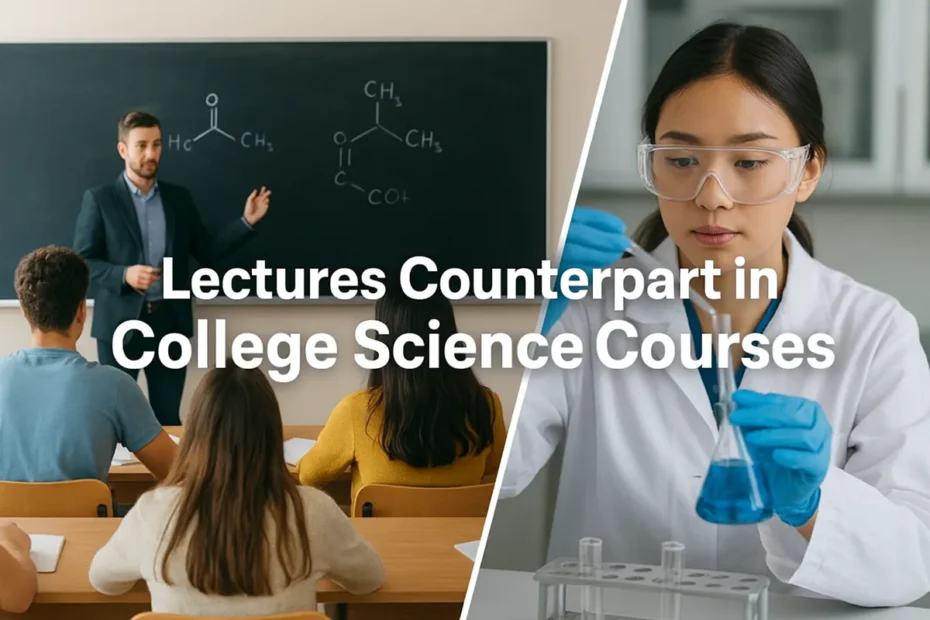
College science courses are designed to provide students with a deep understanding of complex scientific concepts. While lectures are the backbone of these courses, offering theoretical knowledge and foundational principles, they are only one piece of the learning puzzle. To fully grasp the subject matter and develop practical skills, students must engage with the lectures counterpart in college science courses.
What is the Lectures Counterpart?
The term lectures counterpart in college science courses generally refers to the hands-on, interactive components that complement traditional lectures. In most science curricula, this counterpart takes the form of laboratories, tutorials, discussion sessions, and problem-solving workshops. These components are carefully designed to reinforce theoretical learning, enabling students to apply concepts in practical scenarios.
For example, while a lecture on chemical reactions explains reaction mechanisms and principles, the laboratory sessions allow students to witness reactions in real time, conduct experiments, and understand the variables that affect outcomes. This dual approach ensures that students are not just passive recipients of information but active participants in the learning process.
Importance of the Lectures Counterpart
In college science courses, relying solely on lectures can limit a student’s understanding. Scientific concepts often involve abstract ideas, complex equations, and experimental procedures that are difficult to internalize through listening alone. Here’s why the lectures counterpart in college science courses is indispensable:
-
Practical Skill Development: Laboratories and workshops allow students to develop essential scientific skills such as data analysis, precise measurement, and experimental design. These are crucial for success in professional scientific environments.
-
Critical Thinking: By engaging in problem-solving sessions, students learn to formulate hypotheses, test them, and draw logical conclusions. This enhances critical thinking and analytical abilities beyond what a lecture can provide.
-
Active Learning: Interactive sessions encourage students to ask questions, discuss ideas with peers, and receive immediate feedback from instructors. Active learning improves retention and understanding of complex material.
-
Preparation for Research and Careers: For students pursuing careers in research or applied sciences, hands-on experience is invaluable. The lectures counterpart in college science courses serves as a bridge between theoretical knowledge and real-world application.
Common Forms of Lectures Counterparts
Different college science programs implement the lectures counterpart in various ways, depending on the discipline and course objectives. Some of the most common forms include:
-
Laboratory Sessions: Labs are the most recognized counterpart to lectures in subjects like chemistry, biology, and physics. Students perform experiments that reinforce concepts learned during lectures.
-
Tutorials and Problem-Solving Workshops: Particularly common in mathematics and physics courses, these sessions focus on applying theoretical knowledge to solve practical problems.
-
Field Work: In environmental science, geology, or ecology courses, field trips allow students to observe phenomena in their natural settings, bridging the gap between textbook knowledge and real-world science.
-
Discussion Seminars: These sessions emphasize critical thinking and peer learning. Students analyze case studies, discuss experimental results, and debate scientific theories.
How to Make the Most of the Lectures Counterpart
Maximizing the benefits of the lectures counterpart in college science courses requires active engagement and preparation. Here are some tips:
-
Review Lecture Notes Before Sessions: Coming prepared with a basic understanding of the topic makes practical sessions more meaningful.
-
Participate Actively: Ask questions, collaborate with peers, and take detailed notes during labs or workshops.
-
Reflect and Analyze: After each session, review what you’ve learned, analyze results, and connect them to lecture material.
-
Seek Guidance When Needed: Don’t hesitate to ask instructors for clarification or additional resources. The counterpart sessions are meant to complement lectures, not replace them.
Conclusion
In conclusion, while lectures form the core of college science courses, their counterpart, whether in the form of labs, tutorials, or field work, is essential for a holistic learning experience. The lectures counterpart in college science courses allows students to bridge the gap between theory and practice, develop critical scientific skills, and prepare for future careers in science. By actively engaging with these components, students can ensure they gain a deep, practical understanding of the subject matter, making their college education truly valuable.
By integrating both lectures and their counterparts effectively, students can achieve not only academic success but also a practical mastery of scientific principles that will serve them well beyond the classroom.
FAQs:
1. What is the lectures counterpart in college science courses?
The lectures counterpart in college science courses refers to hands-on and interactive components like laboratory sessions, tutorials, field work, and discussion workshops that complement traditional lectures. These sessions help students apply theoretical knowledge in practical scenarios.
2. Why is the lectures counterpart important?
It is important because it develops practical skills, encourages critical thinking, and enhances understanding of complex scientific concepts that lectures alone may not fully convey.
3. What are common examples of lectures counterparts?
Common examples include laboratory experiments in chemistry or biology, problem-solving workshops in physics or math, field studies in environmental sciences, and discussion-based seminars for analyzing scientific theories.
4. How can students make the most of lectures counterparts?
Students should review lecture notes beforehand, actively participate in sessions, analyze results afterward, and seek guidance from instructors to fully benefit from practical components.
5. Do lectures counterparts improve career readiness?
Yes, engaging in laboratories, field work, and practical workshops helps students gain skills and experience essential for research, scientific careers, and real-world applications of science.